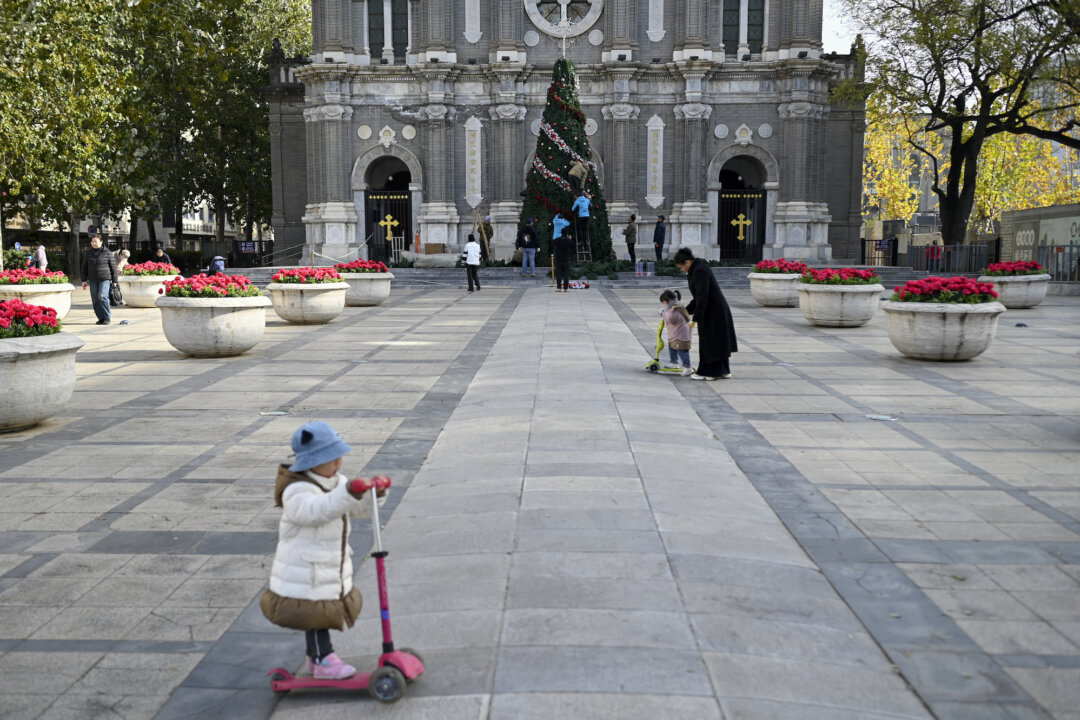
UPDATE: Christmas Eve 2023 unfolded under heavy restrictions in China, as the government intensified controls on religious gatherings and public celebrations. Reports indicate that the Chinese Communist Party (CCP) has effectively stifled holiday festivities, limiting them to state-sanctioned venues and suppressing spontaneous community activities.
In multiple provinces, including Shandong, Zhejiang, and Sichuan, local authorities prevented underground churches from holding Christmas services. Pastor Huang from Qingdao, Shandong, revealed that state security officials explicitly barred congregants from gathering on December 24. “All collective gatherings here are banned,” he stated. Instead, he and his family celebrated quietly at home, reflecting a broader trend of diminished Christmas spirit across the nation.
The crackdown extended beyond house churches. Universities issued stern warnings to students against any Christmas-related expressions. At Dezhou University in Shandong, students received directives prohibiting social media posts about the holiday, with officials indicating that online activity would be closely monitored. Similarly, Northwest University in Shaanxi Province mandated students remain on campus over the holiday, with nightly roll calls to enforce compliance.
In Shanghai, police detained a woman dressed as Santa Claus for distributing apples on the street, highlighting the extreme measures taken against public displays of Christmas cheer. Footage emerged showing individuals in Santa costumes being questioned at a police station, while many commercial Christmas decorations were confined to specific areas or removed entirely. “Christmas can now only exist within clearly defined boundaries,” lamented a local resident, underscoring the stark contrast with previous years’ celebrations.
Reports indicate that the situation is not isolated. A Christian from Fujian Province noted the absence of public Christmas events outside state-sanctioned churches, while in Chengdu, authorities warned churches against hosting gatherings. “There’s almost no Christmas atmosphere anymore,” Mr. Yang, a resident, expressed. He pointed out that Christians were instructed to limit their celebrations to immediate family and attend only state-approved services.
The CCP’s stringent policies dictate that religious activities be restricted to approved venues, forbidding any public displays of holiday spirit. Local governments have continually emphasized that Christmas celebrations should not “expand outward” or be promoted in public spaces. As a result, underground churches have received annual notices prohibiting collective celebrations, with some cities demanding advance attendee lists and conducting inspections.
The crackdown prompted a response from the international community. On December 23, the U.S. Embassy in China shared a holiday video wishing viewers a “joyful, peaceful holiday season!” The video quickly circulated on Chinese social media platforms, receiving mixed reactions and igniting discussions about the regime’s suppression of Christmas celebrations.
As restrictions continue to intensify, the future of Christmas in China remains uncertain. Observers are keenly watching how these developments will affect both local communities and international perceptions of religious freedom in the country.
For those seeking to understand the implications of these actions, the situation presents a critical moment in the ongoing struggle for religious expression in China. With authorities intensifying their grip on celebrations, the impact on the Christian community and broader societal sentiments will be pivotal in the coming weeks.