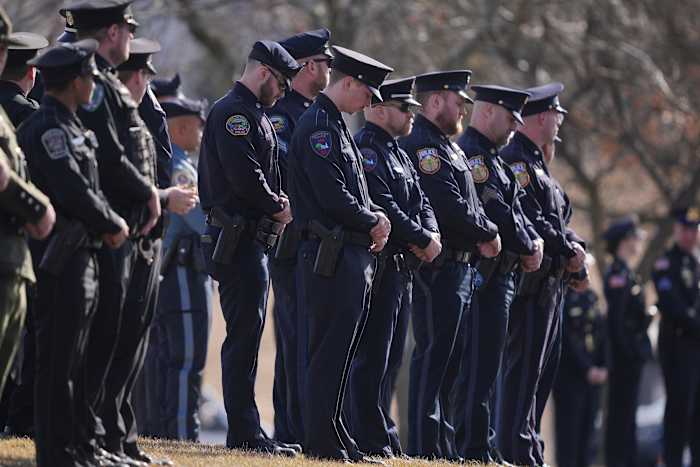
UPDATE: New data confirms a staggering 25% drop in the deaths of on-duty law enforcement officers in the United States, falling from 148 fatalities in 2024 to just 111 in 2025. This urgent report comes from the National Law Enforcement Officers Memorial Fund and was shared with The Associated Press ahead of its release on Tuesday.
The report highlights significant declines across all categories of officer fatalities, including a notable 15% decrease in firearm-related deaths, which fell to 44—the lowest in a decade. “I always like to see that firearms deaths are down. They are the tip of the spear for egregious acts,” said Bill Alexander, CEO of the Fund, emphasizing the importance of these statistics for public safety awareness.
Traffic-related deaths also saw a significant reduction of nearly 23%, attributing this positive trend to increased national dialogue around officer roadway safety. New legislation, such as “move-over” laws, has been enacted in several states, compelling drivers to switch lanes while passing traffic stops or accidents. Additionally, training programs have encouraged officers to approach vehicles from the passenger side during traffic stops, further enhancing their safety.
While the decrease in fatalities is promising, Alexander cautioned that fewer deaths do not equate to fewer shootings. The National Fraternal Order of Police reported an increase in the number of officers shot while on duty, from 342 in 2024 to 347 in 2025. High-profile incidents include the tragic deaths of Andrew Duarte, a police officer shot in February in York, Pennsylvania, and Matthew “Ty” Snook, a Delaware State Trooper who was killed while on duty after heroically pushing a DMV employee out of harm’s way.
The report also highlights that 17 states and Washington D.C. experienced no on-duty officer fatalities last year. The report further indicates a 37% drop in the category of “other” fatalities, which encompasses physical or medical issues resulting from on-duty incidents, decreasing from 52 to 33. This reduction included 14 officers who died from illnesses related to the September 11 terrorist attacks.
Importantly, the report does not account for suicides among officers, a topic Alexander indicates is under discussion for future reporting. The absence of COVID-19 deaths in recent years marks a significant shift in fatality statistics compared to the spikes seen in 2020 and 2021.
As this report sheds light on the ongoing challenges faced by law enforcement, it underscores the crucial need for continued efforts to improve officer safety and well-being on the job. The community response to these findings will be pivotal in shaping future policies and support mechanisms for those in service.
Stay tuned for further updates as this story develops and as we continue to monitor the impact of these changes on officer safety across the nation.