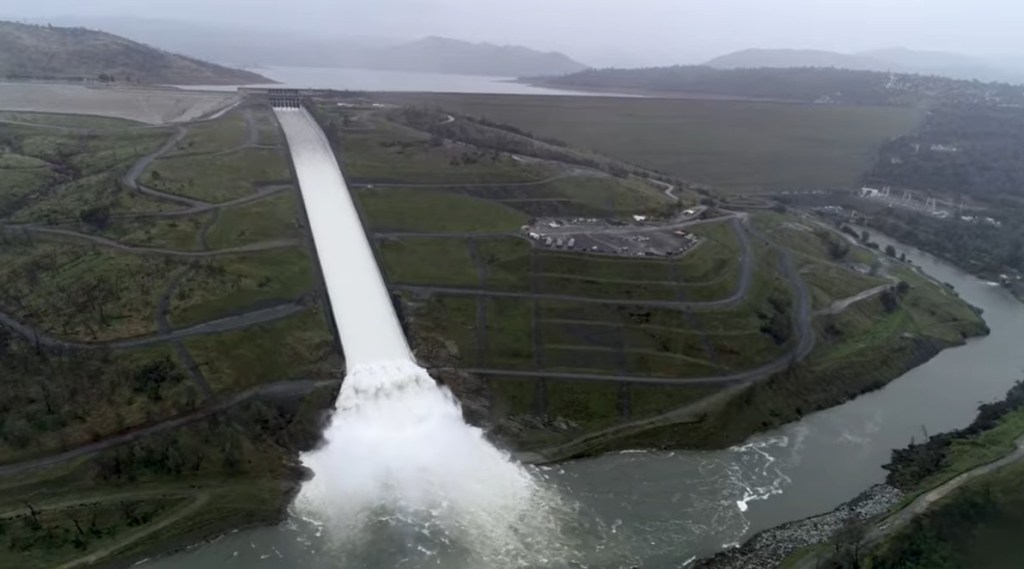
UPDATE: Oroville Dam operators have just announced the release of billions of gallons of water from California’s second-largest reservoir to prevent potential flooding, as heavy storms continue to impact the region. Engineers opened the spillway gates early Monday morning, releasing water into the Feather River as reservoir levels rise dramatically.
Since December 16, the watershed around the Oroville Reservoir has experienced an astonishing 12 inches of rain, leading to a surge in water levels. The reservoir has filled from 51% to 75% full in just three weeks, reaching 136% of its historical average for this time of year. The volume of water has increased by over 837,554 acre-feet, enough to supply 4.2 million people for a year.
At 6 a.m. on Monday, the Department of Water Resources (DWR) opened the gates on Oroville’s massive spillway, which spans as wide as 15 lanes of freeway. This decision was made to manage water storage effectively, as the reservoir continues to rise about 3 feet per day. Currently, the inflow is nearly double the outflow, with around 29,051 cubic feet per second entering the reservoir.
As reservoir levels rise, DWR has increased water releases from 1,856 cubic feet per second on Christmas Day to 16,135 cubic feet per second on Monday. However, following two dry days, flows were reduced to 12,842 cubic feet per second on Wednesday, with expectations of further reductions in the coming days due to a forecast of sunny weather.
The Oroville Dam serves as a critical component of California’s water supply, distributing water to cities and farms from San Jose to San Diego. This facility, built by former California Governor Pat Brown in 1967, is a barometer for the state’s water conditions, reflecting both droughts and deluges.
Historically, the dam has faced significant challenges, including the infamous spillway collapse in 2017, which forced the evacuation of 188,000 people. A subsequent $1 billion reconstruction project upgraded the facility, ensuring robust safety measures.
As California navigates this winter’s wet conditions, water experts are hoping for additional storms in February and March to further enhance reservoir levels and build the Sierra Nevada snowpack, which provides 30% of the state’s water supply.
With the current surge in water levels, the focus remains on balancing reservoir management to prevent flooding while maximizing water storage for future use. Residents downstream are urged to stay informed as officials continue to monitor the situation closely.
Stay tuned for the latest updates on this developing story.