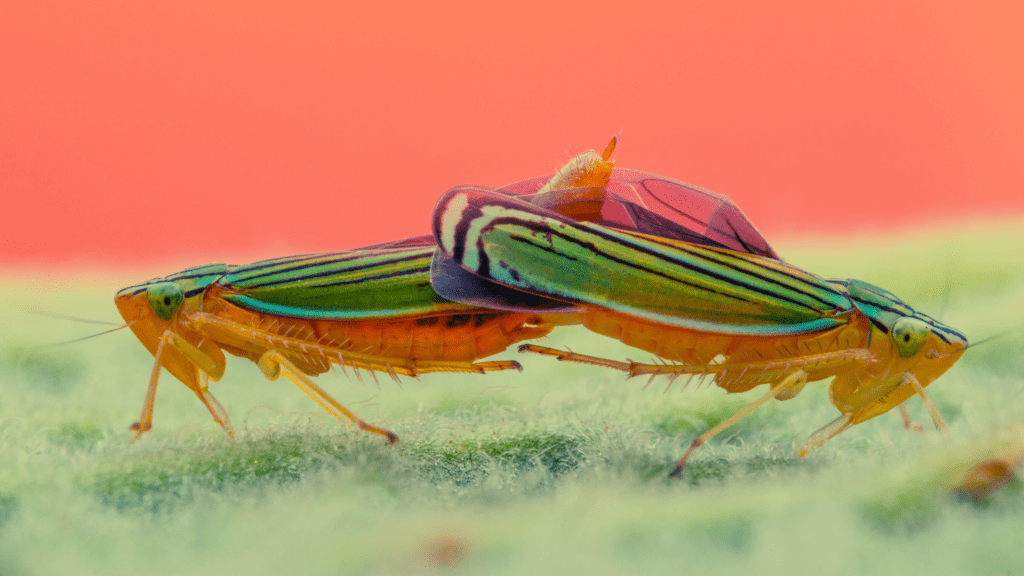
BREAKING: Scientists at Penn State University have just announced a groundbreaking development in insect-inspired technology, successfully replicating the remarkable camouflage abilities of common leafhoppers. Their research, published in ACS Nano this month, reveals how these tiny insects achieve their incredible disappearing act by utilizing microscopic particles that minimize glare and enhance invisibility.
Leafhoppers, often unnoticed due to their remarkable blending capabilities, can reduce reflected light by an astonishing 80 to 96 percent across both visible and ultraviolet spectrums. This drastic reduction makes them nearly undetectable to predators that rely on light reflection for hunting.
The innovative Penn State team developed a chemical approach to replicate this effect in the lab. They engineered a microfluidic system capable of producing microscopic droplets filled with dissolved polymers. As the solvent evaporates, these polymers form hollow spheres, closely mimicking the natural brochosomes found on leafhoppers, which are responsible for their camouflage.
Notably, the system can generate over 100,000 particles per second, vastly outpacing traditional nanofabrication methods. Researchers successfully recreated five distinct brochosome designs observed in various leafhopper species, with sizes ranging from a few hundred nanometers to approximately two micrometers.
The implications of this research extend far beyond insect mimicry. The potential applications are broad, spanning energy devices that could benefit from reduced glare to advanced optical materials. Although military camouflage applications have been mentioned, further testing is required for practical implementation. Biomedical uses, particularly in drug delivery systems, also show promise due to the unique shape and surface properties of the particles, although these applications remain theoretical at this stage.
What makes this study particularly fascinating is the simplicity of its source. A common backyard insect, equipped with a natural mechanism for light management, has inspired scientists to create scalable technology. This innovation not only showcases nature’s ingenuity but also highlights the potential for everyday species to inform advanced scientific breakthroughs.
As this research develops, the world will be watching closely for future applications of these ‘invisible’ particles. The possibilities are vast, and the urgency of this discovery underscores a significant leap forward in material science and technology.
Stay tuned for more updates on this exciting story as it unfolds, and consider sharing this remarkable achievement in science with your network.