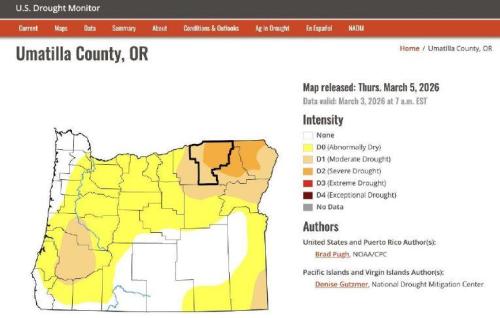
BREAKING: Umatilla County has officially declared a drought, a crucial move following an unusually dry winter. This urgent announcement was made during the county commissioners’ meeting on March 4, 2023, and highlights that the entire county is experiencing moderate drought conditions, with roughly half classified as severe.
County emergency manager Sage Delong reported that the eastern part of the county faces the most severe drought, as confirmed by the U.S. Drought Monitor. Delong emphasized that despite some recent precipitation, the situation remains dire, impacting soil moisture, runoff potential, and water supply outlook.
“Precipitation across much of the region has been below normal,” Delong stated. “This has created reduced soil moisture and uncertainty in spring runoff conditions.” Alarmingly, this year’s snowpack is reported to be 15% to 45% below median levels, which could severely limit water availability for irrigation and municipal needs.
The implications of this drought declaration are significant. If conditions persist, it may exacerbate wildfire risks and strain the water supply for both agricultural and municipal uses. The declaration allows for the possibility of a state emergency, which can unlock critical resources for farmers and ranchers facing unprecedented challenges.
County Commissioner and Board Chair Dan Dorran noted that state endorsement of the drought declaration could lead to federal funding to support agricultural producers. “This declaration will enable the Oregon Water Resources Department to optimize water availability,” Dorran stated, with expectations of a state decision on the emergency declaration within the next two weeks.
Local water expert JR Cook, founder of the Northeast Oregon Water Association, highlighted that the drought declaration facilitates crucial water transfers from the Columbia River, lessening the impact on local groundwater systems. “The declaration makes it easier and quicker to get water to the most valuable crops,” Cook explained.
Farmers are anxious to understand their water situation for the upcoming growing season. With snowpack levels significantly below average, experts like Cook stress that even a wet spring will not compensate for the deficit. “We’re already seeing major impacts, and this could be one of the worst perfect storms for agriculture in decades,” Cook warned.
Additionally, rising input costs due to global events, including those stemming from the war in Iran, threaten to compound the struggles faced by farmers. “Farmers are doing their best to provide food, but without addressing the drought, the pressure will only increase,” he added.
While the region has made strides in developing a sustainable water supply system, the challenges ahead remain daunting. Cook noted that maintaining aquifer storage and recovery systems has been essential for building resilience against adverse conditions. “You can’t plan for a drought the year it happens. We’ve been working on these systems for years, and they’re critical this year,” he remarked.
As Umatilla County moves forward, the urgency of the situation cannot be overstated. The potential for state intervention could alleviate some burdens for farmers, allowing them to better prepare for the growing season under these challenging circumstances.
Stay tuned for updates as the county navigates these pressing drought conditions and seeks essential support for its agricultural community.