Denmark has expressed its support for an upcoming meeting with the United States focused on discussions surrounding Greenland, following renewed interest from former President Donald Trump regarding the island’s strategic importance. Danish Defense Minister Troels Lund Poulsen emphasized that this gathering represents “the dialogue that is needed,” reflecting a collaborative approach between the Danish government and the Greenlandic authorities. The discussions are scheduled for next week, as confirmed by U.S. Secretary of State Marco Rubio, who did not provide details on the timing or participants.
Greenland’s government has made it clear that it will actively participate in these discussions. Foreign Minister Vivian Motzfeldt stated, “Nothing about Greenland without Greenland. Of course we will be there. We are the ones who requested the meeting,” underscoring the island’s desire to be included in conversations that directly affect its future.
The island, which is predominantly inhabited by approximately 56,000 Inuit people, has recently come under scrutiny from U.S. officials. U.S. Vice President JD Vance commented that Denmark has not adequately secured Greenland, suggesting that Trump “is willing to go as far as he has to” to protect American interests in the Arctic. Vance highlighted that Greenland plays a crucial role in the United States’ national security framework, noting the dependency of missile defense infrastructure on the island.
In a recent interview, Vance reiterated Trump’s perspective that Greenland is vital for both the U.S. and global security interests. He remarked, “Just because you did something smart 25 years ago doesn’t mean you can’t do something dumb now,” signaling a push for a more proactive U.S. stance regarding Greenland’s governance.
The conversation around Greenland is not just limited to military interests. Antonio Costa, the President of the European Council, emphasized that “Greenland belongs to its people,” reinforcing the idea that decisions affecting the island cannot be made without its own government. Costa also expressed solidarity from the European Union, stating that both Denmark and Greenland have the EU’s full support.
As these discussions unfold, key leaders from Canada, France, Germany, Italy, Poland, Spain, and the United Kingdom have rallied behind Mette Frederiksen, Denmark’s Prime Minister, in defending Greenland’s sovereignty following the remarks from U.S. officials. This international backing highlights the global importance of Greenland’s status in the geopolitical landscape.
In the context of military presence, Danish Foreign Minister Lars Løkke Rasmussen pointed to a 1951 defense agreement between Denmark and the U.S. He indicated that while the American military presence in Greenland has diminished since 1945, there are opportunities within the agreement for a stronger U.S. military foothold if desired. Currently, the U.S. maintains a small contingent at the Pituffik Space Base, which is critical for missile warning and space surveillance operations.
In response to evolving security needs, Denmark has committed to enhancing its military capabilities in the Arctic region. Last year, the Danish parliament approved a significant investment of 14.6 billion kroner ($2.3 billion) aimed at improving surveillance and sovereignty capabilities in Greenland and the North Atlantic. This plan includes the acquisition of three new Arctic naval vessels, additional long-range surveillance drones, and boosted satellite capacity.
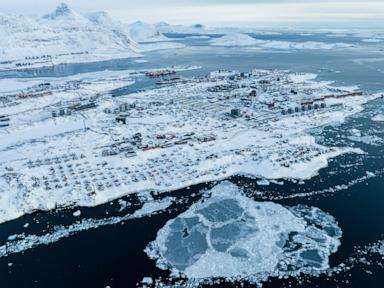
The Joint Arctic Command, based in Nuuk, is responsible for the surveillance and military defense of Greenland and the Faroe Islands. This command is supported by specialized units, such as the Sirius Dog Sled Patrol, which enforces Danish sovereignty in the Arctic wilderness.
As Denmark prepares for the upcoming talks with the United States, the focus remains on ensuring that Greenland’s voice is central to any discussions regarding its future. The outcome of these negotiations could have significant implications for the island’s governance, security, and international relations in the Arctic region.