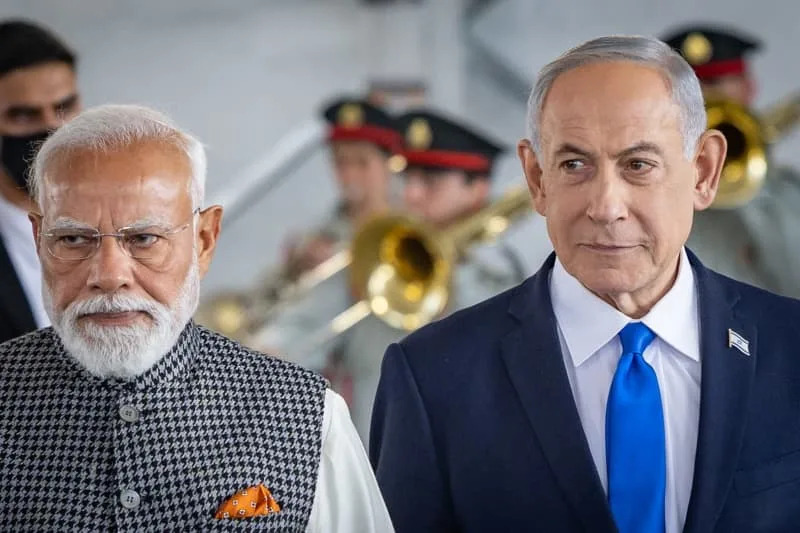
India is poised to finalize a significant defense agreement with Israel during Prime Minister Narendra Modi‘s visit to Jerusalem, with estimates suggesting the deal could reach between $8 billion and $10 billion. This anticipated agreement comes in the wake of the 2023-2025 Middle East war, which underscored the effectiveness of Israeli air-defense systems, as well as the May 2025 conflict between India and Pakistan that exposed vulnerabilities in New Delhi’s defense capabilities.
The negotiations are expected to cover all four major components of Israel’s multilayered missile defense systems. These include the Israel Aerospace Industries (IAI) Arrow missile-defense system, Rafael’s David’s Sling and Iron Dome, as well as Rafael and Elbit’s Iron Beam. Such a comprehensive package would enhance India’s capabilities against long-range ballistic missiles, medium-range rockets, cruise missiles, and short-range rockets.
In addition to missile defense, the agreements are likely to encompass advancements in both offensive and defensive drone warfare. Israeli companies are actively competing to provide various solutions, with a substantial deal anticipated for Elbit’s Hermes 900 drone. There are also expected agreements for Rafael’s SPICE 1000 guidance kits, Elbit’s Rampage air-to-ground missiles, and IAI’s Air LORA supersonic missiles.
Reports indicate that Prime Minister Modi aims to enhance India’s capability to launch missiles from distances that remain beyond the reach of enemy air defenses, similar to tactics employed by the Indian Air Force in June 2025 against Iran.
India has long been a key partner for Israel in defense procurement. According to the Stockholm International Peace Research Institute (SIPRI), India accounted for 34% of Israel’s total arms sales from 2020 to 2024, with total arms sales valued at approximately $20.5 billion. The trajectory of defense sales has seen significant growth; between 2012 and 2017, sales surged to $3.4 billion when Israel supplied India with the Barak anti-aircraft system for naval vessels.
However, the market cooled slightly from 2017 to 2023 as both countries adapted to Modi’s “Made in India” policy, which emphasizes domestic production. By 2024, Israel began to increase its investments in India, with multiple defense firms establishing subsidiaries in the country. This shift towards a combination of purchases and long-term industrial partnerships is expected to drive a resurgence in defense deals, potentially surpassing previous records by 2026.
As part of Modi’s visit, discussions are also likely to include a range of cyber, artificial intelligence, and quantum technology joint ventures, further solidifying the strategic partnership between India and Israel. The forthcoming agreements reflect not only military interests but also a growing collaboration in advanced technologies, which could have lasting implications for both nations.