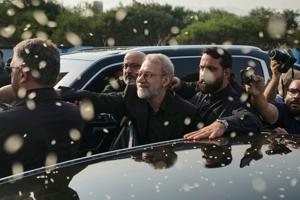
A high-ranking Iranian security official, Ali Larijani, arrived in Oman on October 10, 2023, for discussions likely focused on nuclear negotiations with the United States. This visit marks a significant development as Oman takes on the role of mediator between Tehran and Washington, following initial indirect talks held in Muscat last week. Larijani, serving as the secretary of Iran’s Supreme National Security Council and a former parliament speaker, met with Oman’s Foreign Minister Badr al-Busaidi to discuss the ongoing diplomatic efforts to halt potential military action by the U.S. against Iran.
Photos shared by Larijani’s team depicted him alongside al-Busaidi, who is central to the U.S.-Iran negotiations. A conspicuous item during their meeting was a letter, secured in plastic, which was placed next to al-Busaidi. Historically, Iran has opted for written communications in its dealings with the U.S., including a notable instance in 2019 when Japan’s then-Prime Minister Shinzo Abe attempted to deliver a letter from then-President Donald Trump to Iranian Supreme Leader Ayatollah Ali Khamenei, which Khamenei declined to accept.
While Iranian media suggested that Larijani intended to deliver a significant message during his visit, state television later reported that al-Busaidi handed over a letter to Larijani without detailing its origin. Larijani’s agenda also included a nearly three-hour conversation with Oman’s Sultan Haitham bin Tariq, as reported by the state-run IRNA. The content of these discussions remains undisclosed by both Iranian and Omani officials.
Following his time in Oman, Larijani is expected to travel to Qatar, where the U.S. maintains a substantial military presence. This visit comes after Iran conducted attacks on U.S. interests in the region amid heightened tensions following the Iran-Israel conflict earlier this year.
The recent talks in Oman involved Abbas Araghchi, Iran’s Foreign Minister, who emphasized Iran’s position on the necessity of uranium enrichment. This issue remains a critical point of contention with the U.S., particularly under Trump’s administration. Araghchi noted that discussions largely revolved around generalities and were intended to gauge the seriousness of the U.S. stance.
“Our principles are clear,” Araghchi remarked during a press briefing, asserting Iran’s commitment to securing the nation’s interests in alignment with international norms and the Non-Proliferation Treaty. He indicated that the details of the negotiations would unfold as the diplomatic process continues.
In parallel, Israeli Prime Minister Benjamin Netanyahu is visiting Washington this week, where discussions surrounding Iran are anticipated to be a focal point. U.S. Ambassador to Israel Mike Huckabee expressed a strong alignment between the U.S. and Israel regarding the negotiations with Iran, stating that both nations hope for a peaceful resolution.
To reinforce its stance, the U.S. has positioned the aircraft carrier USS Abraham Lincoln and other military assets in the Middle East. This deployment aims to apply pressure on Iran while ensuring the capability of a military response if necessary. Recently, U.S. forces intercepted a drone that had approached the Lincoln and intervened to assist a U.S.-flagged vessel threatened by Iranian forces in the strategic Strait of Hormuz.
The U.S. Transportation Department has since issued a warning to American vessels navigating the strait, advising them to maintain distance from Iranian territorial waters to ensure safe passage. This area is crucial for global oil trade, with approximately one-fifth of the world’s oil moving through these waters.
As the diplomatic landscape evolves, the outcomes of Larijani’s meetings in Oman may play a pivotal role in shaping the future of U.S.-Iran relations and the ongoing negotiations surrounding Iran’s nuclear program.