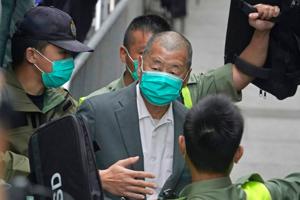
Jimmy Lai, a prominent pro-democracy activist and former media tycoon, was sentenced to 20 years in prison on March 4, 2024, marking the longest punishment imposed under the national security law introduced by Beijing. Lai, aged 78, was convicted of conspiring with foreign forces to undermine national security and of conspiracy to publish seditious articles. The maximum penalty for these charges could have reached life imprisonment.
Lai’s sentencing is viewed by many as a significant blow to press freedom in Hong Kong, a city once celebrated for its media independence. His conviction, along with that of six former employees of his now-defunct newspaper, Apple Daily, raises further concerns about the state of civil liberties in the region. The co-defendants received prison terms ranging from 3 years and 3 months to 10 years for their roles in collusion-related activities.
Upon his arrival at the courtroom, Lai acknowledged supporters with a smile but appeared serious as he left, while some in the public gallery were visibly emotional. When asked about the possibility of an appeal, Lai’s lawyer, Robert Pang, refrained from making a comment.
The Hong Kong government has defended the prosecution, asserting that it is unrelated to press freedom, claiming that the defendants exploited journalism as a cover for actions harmful to China and Hong Kong. Lai was among the first high-profile figures arrested under the security law in 2020, which has since been used to suppress dissent and silence opposition voices.
Lai’s sentencing is expected to exacerbate diplomatic tensions between Beijing and foreign governments. U.S. President Donald Trump expressed his dismay over the verdict, mentioning that he had discussed Lai’s case with Chinese leader Xi Jinping, urging him to consider granting Lai’s release. Similarly, British Prime Minister Keir Starmer’s government called for Lai’s freedom, with U.K. Foreign Secretary Yvette Cooper labeling the prosecution as politically motivated, while Australian Foreign Minister Penny Wong expressed deep concern over the harsh sentencing.
In a statement, Lai’s son, Sebastien, described the prison term as “draconian” and devastating for the family, asserting it indicates the “total destruction of the Hong Kong legal system.” His sister, Claire, called the sentence “heartbreakingly cruel,” predicting that if served, it would lead to his death in custody.
Hong Kong leader John Lee stated that Lai’s sentence reflects the rule of law, citing the seriousness of his crimes as justification. The judges overseeing the case described Lai as the mastermind behind the conspiracies, thus warranting a more severe sentence, but they also acknowledged his age and health conditions when determining the length of his imprisonment.
Urania Chiu, a lecturer in law at Oxford Brookes University, highlighted the implications of Lai’s case for journalists, noting the broad interpretation of seditious intent and the risks associated with engaging with international media platforms.
Lai, who has been in custody for over five years, has experienced health issues, including heart palpitations and diabetes. Despite this, the prosecution maintained that his condition is stable. The former Apple Daily employees and activists involved in the case pleaded guilty to charges of conspiring with Lai to solicit foreign sanctions against Hong Kong and China, which contributed to their reduced sentences.
The closure of Apple Daily in June 2021 came as a shock to the media landscape in Hong Kong, where the press-freedom index has significantly declined, ranking 140th out of 180 territories, down from 18th in 2002.
Steve Li, chief superintendent of the police force’s National Security Department, welcomed the sentence as a necessary measure against those undermining Hong Kong’s stability. Meanwhile, Human Rights Watch’s Asia Director Elaine Pearson condemned the sentence as effectively a death sentence for Lai, labeling it both cruel and unjust.
This case underscores the ongoing struggle for press freedom and civil liberties in Hong Kong, raising critical questions about the future of dissent in the region.