Tensions in Northeast Asia are escalating as North and South Korea intensify their efforts to develop nuclear-powered submarines. This arms race is partly driven by shifts in the United States’ security strategy in the region, prompting both nations to bolster their military capabilities amid growing concerns over regional stability.
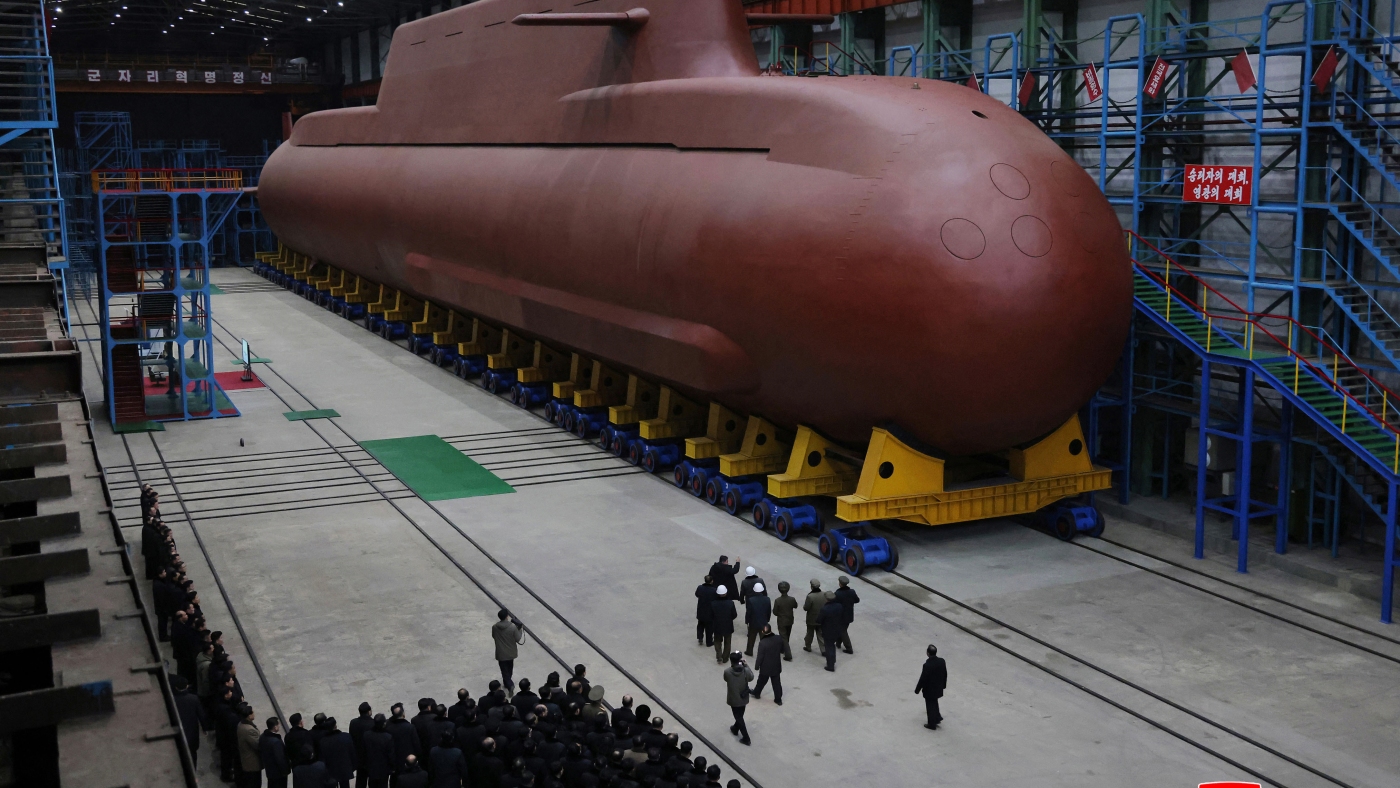
On March 7, 2024, North Korean state media unveiled an image of what it claims to be an “8,700-ton nuclear-powered strategic guided missile submarine.” This announcement marks the first time North Korea has disclosed the tonnage and the apparently completed hull of the submarine since committing to its nuclear submarine program in 2021. North Korean leader Kim Jong Un emphasized that this new vessel will serve as a critical defense mechanism against what he termed “the negative security situation that has come as present reality.” He characterized South Korea’s initiative to pursue its own nuclear submarines as an “offensive act … that must be countered.”
In response, South Korea is moving swiftly to establish its own nuclear submarine capabilities. Following President Donald Trump‘s approval in October 2023, a pan-government task force was launched in Seoul. The country’s National Security Adviser, Wi Sung-lac, announced plans to negotiate a pact with the U.S. for military-use nuclear fuel. This development aligns with U.S. efforts to encourage its allies to shoulder more of their defense responsibilities.
The South Korean government has long sought to develop nuclear submarines as a countermeasure against North Korea’s expanding maritime nuclear threats. Over recent years, North Korea has not only pursued nuclear-powered submarines but has also conducted tests of submarine-launched nuclear missiles and claimed to have developed a nuclear-capable torpedo. In October 2023, South Korea’s Defense Minister, Ahn Gyu-back, remarked that conventional, diesel-powered submarines “can’t compete with nuclear subs North Korea is building in underwater endurance and speed.”
U.S. Expectations and Regional Implications
The United States anticipates that future South Korean nuclear submarines will serve broader strategic purposes beyond countering North Korea. During a visit to Seoul in November 2023, Admiral Daryl Caudle, chief of naval operations for the U.S. Navy, stated that it is “a natural expectation” for these submarines to assist in addressing what the U.S. identifies as its primary concern: China’s military advancements.
President Lee Jae Myung of South Korea acknowledged this expectation during his October summit with Trump, highlighting the limitations of diesel submarines in monitoring activities in the waters adjacent to both North Korea and China. Retired South Korean navy captain Yoon Sukjoon noted that South Korean nuclear submarines would likely operate beyond the Korean Peninsula, contributing to strategic deterrence against potential Chinese naval threats in the Indo-Pacific.
While South Korea acknowledges the necessity for enhanced military capabilities, it remains cautious about suggesting military confrontation with China, its largest trading partner. Following President Lee’s remarks to Trump, his office clarified that the comments were not directed at specific countries but referred generically to submarines operating in proximity to North Korea and China. This cautious stance reflects a broader sentiment among the South Korean public, with a recent survey indicating that a majority support maintaining neutrality in the event of conflict between the U.S. and China.
Concerns Over Regional Security and Nuclear Armament
The geopolitical landscape is further complicated by rising concerns about China’s expanding influence in the region. Both South Korea and Japan are wary of falling under China’s sphere of influence. Kim Heungkyu, a political scientist at Ajou University, asserts that as the U.S. shifts its defense focus closer to home, allied nations are increasingly skeptical of America’s commitment to security in Asia.
A poll conducted by the Asan Institute in March 2024 revealed that less than half of South Koreans believe the U.S. would respond with nuclear weapons if North Korea were to launch an attack on the South. This skepticism has led to a majority of South Koreans supporting the idea of nuclear armament, even at the potential cost of international sanctions or the withdrawal of U.S. troops. Kim argues that in a future where the U.S. may not play a central role in the Western Pacific, South Korea must devise a survival strategy that includes nuclear capabilities.
While the South Korean government is pursuing discussions with the U.S. regarding access to uranium enrichment and the reprocessing of spent fuel, it has officially denied intentions to develop nuclear weapons. However, analysts suggest that U.S. policies are inadvertently nudging both South Korea and Japan towards a path of nuclear armament, whether that outcome is intended or not.
As this arms race unfolds, the implications for regional security and international relations remain profound. The actions of North and South Korea will play a pivotal role in shaping the future military landscape of Northeast Asia, with potential consequences that extend well beyond their borders.