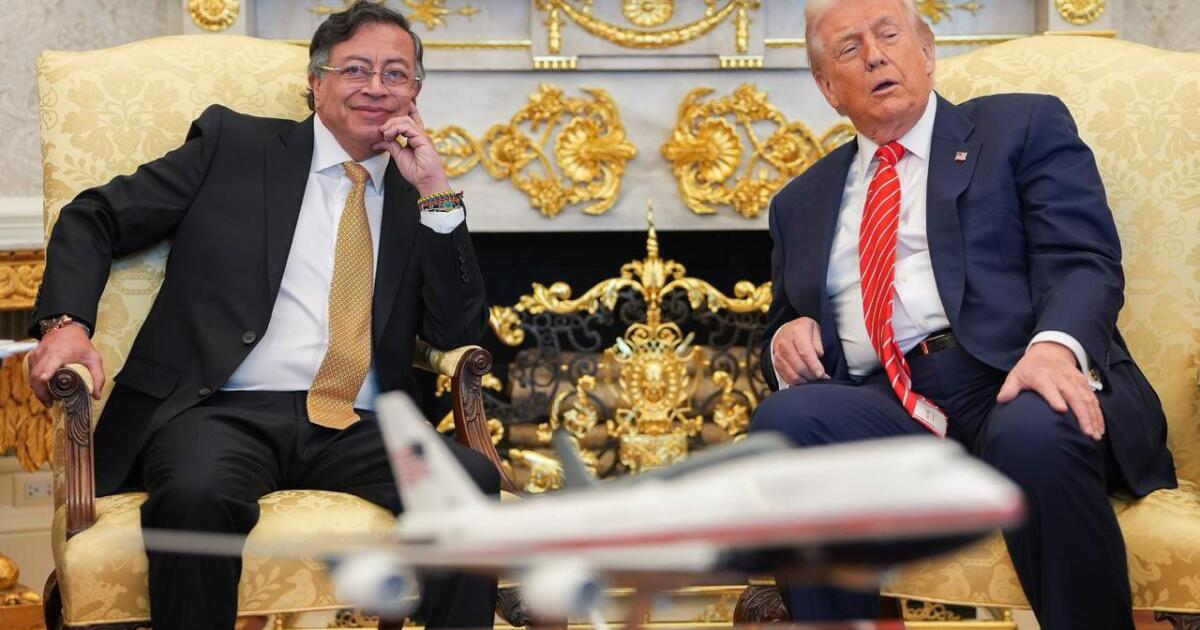
President Donald Trump and Colombian President Gustavo Petro held a significant meeting at the White House on January 7, 2024, aimed at easing the strained relations between their countries. This closed-door discussion, lasting two hours, covered a range of topics including energy cooperation, the situation in Venezuela, and collaborative efforts to combat drug trafficking. Following the meeting, both leaders expressed optimism about their dialogue, with Trump describing it as “fantastic” and Petro labeling it “very positive.”
The relationship between the United States and Colombia has faced considerable challenges over the past year, marked by public disputes and escalating tensions. Notably, Trump had previously referred to Petro as a “sick man who likes making cocaine and selling it to the United States.” In contrast, Petro has accused Trump of being a murderer and likened him to Adolf Hitler. This backdrop made their recent meeting all the more critical.
During their encounter, Petro brought Colombian coffee as a gift and presented Melania Trump with a gown made by indigenous artisans. In return, Trump gifted Petro a framed portrait of their handshake, inscribed with the words: “I love Colombia.” While the meeting did not resolve the fundamental political differences between the two leaders—Trump advocating for U.S. dominance in the Western Hemisphere and Petro opposing recent U.S. military actions in Venezuela—it did serve to alleviate some immediate tensions.
Relations soured sharply after Trump resumed his presidential term, particularly when Petro initially rejected U.S. military flights carrying deported migrants. This led to a threat of heavy tariffs on Colombian imports from Trump. Tensions escalated further after Petro’s speech at the United Nations General Assembly, where he criticized U.S. support for Israel and called for American soldiers to prioritize humanitarian orders over Trump’s directives. In response, the State Department revoked visas for Petro and several family members, heightening diplomatic strains.
The situation reached a peak following a U.S. military operation in Caracas that resulted in the capture of Venezuelan President Nicolás Maduro. Petro condemned this action as a “kidnapping” and challenged Trump, saying, “Come get me. I’m waiting for you here.” Trump did not dismiss the idea of a similar military operation in Colombia, stating, “It sounds good to me.”
Despite the past animosities, the January 7 phone call between the leaders laid the groundwork for their in-person meeting. The United States granted Petro a temporary visa, allowing him to visit the White House. Colombian officials noted that Petro aimed to defend his administration’s record on drug trafficking, despite increasing cocaine production in Colombia.
Acting Minister of Justice Andrés Idárraga Franco indicated that Petro’s administration has extradited more criminals to the United States than previous conservative governments, highlighting efforts to combat drug trafficking. This included the recent extradition of an alleged trafficker to U.S. authorities.
Typically, reporters have access to the Oval Office during meetings with foreign leaders; however, this time, no press was allowed. After the meeting, Trump acknowledged their rocky past, stating, “You know, he and I weren’t exactly the best of friends. But I wasn’t insulted because I’d never met him. I didn’t know him at all. And we got along very well.”
At the Colombian Embassy in Washington later that day, Petro touched on various issues, including climate change, the U.S. operation in Venezuela, and what he termed the “genocide” in Gaza. He also humorously recounted how he modified Trump’s campaign slogan, adding an “s” to create “Make Americas Great Again,” reflecting his focus on unity across the continent.
The meeting represents a potential thaw in U.S.-Colombia relations, which have historically been marked by cooperation but have faced significant challenges in recent years. As both leaders move forward, the impact of their discussions on drug trafficking and regional stability will be closely monitored by both nations and beyond.