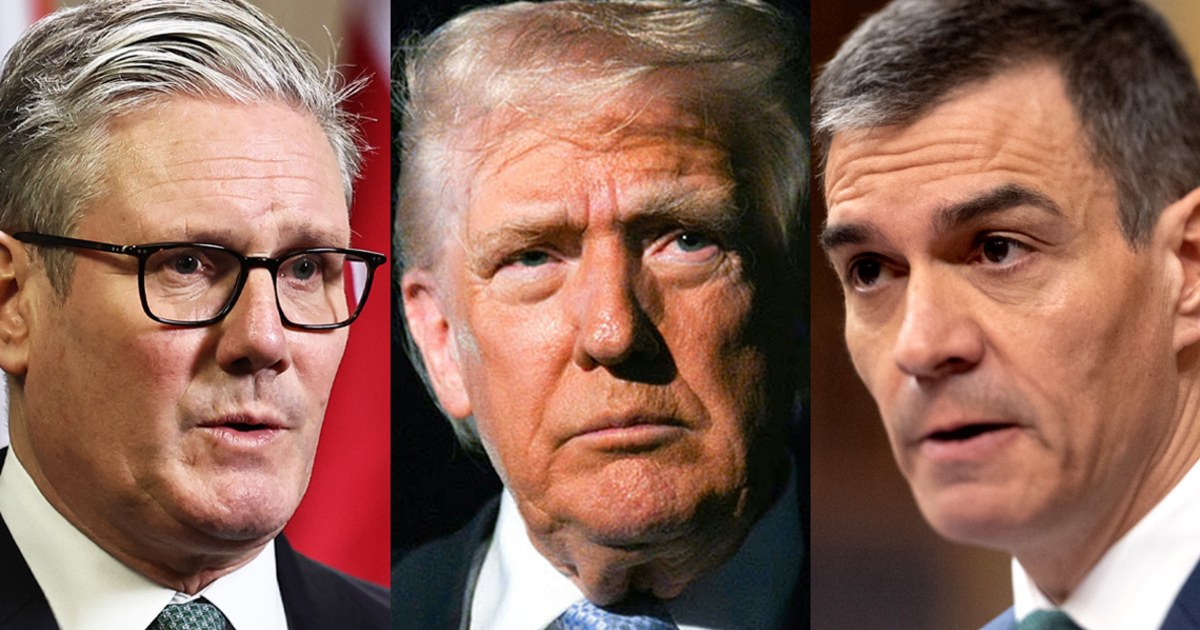
President Donald Trump has expressed frustration with European allies in light of their mixed responses to military actions against Iran. Following a year marked by diplomatic tensions, including tariff threats and insults, the U.S. President finds himself with limited support as he navigates this conflict, primarily relying on Israel as an ally.
Trump’s discontent became evident after U.K. Prime Minister Keir Starmer initially declined to allow U.S. forces to use British bases for their operations against Iran. While Starmer later permitted the use of bases for “defensive” actions, the refusal to support initial strikes ignited Trump’s ire. Speaking on Monday, Trump remarked, “This is not Winston Churchill that we’re dealing with.”
The situation escalated further when Spain barred U.S. military planes from accessing its bases in Andalusia. In response, Trump threatened to “cut off all trade with Spain,” highlighting the potential economic ramifications for a country that is part of the European Union’s single market. France also drew Trump’s ire when President Emmanuel Macron stated that the strikes on Iran were “outside the framework of international law.”
Despite the tension, some leaders have managed to maintain a cordial relationship with Trump. Germany’s Chancellor Friedrich Merz has remained in the President’s good graces by allowing the U.S. to use the Ramstein Air Base. Trump praised Germany, stating, “Germany’s been great. They’re letting us land in certain areas, and we appreciate it.”
Italy’s Prime Minister Giorgia Meloni also received commendation from Trump. Reports indicate that Meloni assured Trump that Italy would uphold existing agreements on military base usage. In a recent phone interview, Trump described her as a “great leader” who “always tries to help.”
The White House Press Secretary Karoline Leavitt emphasized that Trump expects cooperation from all European allies in what he considers a crucial mission, asserting that Iran poses a threat to Europe as well. This expectation comes amidst a backdrop where European nations played significant roles in previous military interventions but are now exhibiting caution regarding the conflict in Iran.
Concerns have been raised about a potential diplomatic divide escalating into a trade confrontation. Nevertheless, Fawaz Gerges, a professor at the London School of Economics, suggests that the situation may not be as dire as it appears. He stated, “We should not be deceived into believing that the European governments do not really support the United States in Iran.” Gerges pointed out that while rhetoric may vary, European governments are still likely to offer support through naval and air deployments.
European Union foreign policy chief Kaja Kallas has also commented on the shifting dynamics, noting that Washington’s policy changes have significantly impacted trans-Atlantic relations. She condemned Iran as “an exporter of war” and accused it of attempting to “sow chaos” in the region. Despite disagreements with Trump, many European leaders feel a continued dependence on the American strategic umbrella.
In a notable display of unity, nations including Spain, Italy, France, and the Netherlands have deployed naval and air assets to Cyprus, after an Iranian-made drone targeted a British base there. Spain has sent its most advanced warship to the eastern Mediterranean, reinforcing its commitment to European defense cooperation despite reluctance to support Trump’s military actions.
In response to the situation, the British Ministry of Defense announced that one of its two aircraft carriers is on advanced readiness, leading to speculation of a deployment to the Mediterranean. Trump reacted to Starmer’s decision on social media, asserting, “That’s OK, Prime Minister Starmer, we don’t need them any longer. We don’t need people that join wars after we’ve already won!”
As requests for European support from the U.S. continue, the nature of trans-Atlantic relations remains uncertain. Michael Bociurkiw, a senior fellow at the Atlantic Council, noted that Trump is beginning to recognize the importance of Europe. “I think Trump has come to realize that Europe is important,” he said, adding that European governments might need to act more independently moving forward.
In a surprising twist, Volodymyr Zelenskyy, the President of Ukraine, has now become a point of assistance for the U.S. in its conflict with Iran. Zelenskyy disclosed that the United States requested help with anti-drone defenses, given Ukraine’s experience with Iranian-designed drones used by Russia. “We received a request from the United States for specific support in protection against ‘Shaheds’ in the Middle East region,” Zelenskyy stated on social media.
As the geopolitical landscape evolves, the responses from European nations and the dynamics between the U.S. and its allies will continue to play a pivotal role in shaping the outcome of the situation in Iran.