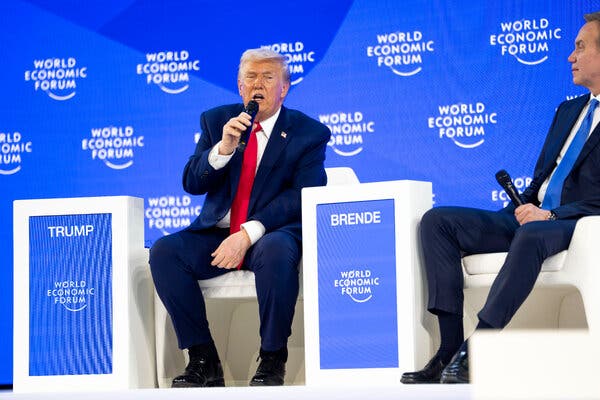
President Donald Trump has once again stirred concerns in global trade, threatening European nations with punitive measures unless they comply with his demands regarding Greenland. Over four days, these threats raised alarms, leading to a significant drop in stock markets and prompting European leaders to hold emergency meetings. The urgency of these discussions arose as they scrambled to address the potential fallout from Trump’s trade ultimatums, which included plans to impose tariffs on eight European countries starting on February 1, 2024.
In a sudden turn, Trump announced that he had reached “the framework of a future deal” concerning Greenland and the Arctic. Details regarding this purported agreement remain scarce, but he characterized it as a “great one” for the United States. Following this announcement, he indicated that the planned tariffs no longer needed to take effect, resulting in a sharp rebound in stock markets.
This back-and-forth approach exemplifies Trump’s unpredictable style, leaving behind a trail of uncertainty in global trade. The abruptness of his threats and subsequent retractions can damage the fragile trust among trading partners. In a climate where businesses and foreign governments hoped for reduced tariff uncertainty, Trump’s actions have injected fresh chaos into the global trading landscape.
As the second year of Trump’s second term unfolds, he has had numerous opportunities to reshape the global trading order according to his vision. Instead of stabilizing relationships with key allies, his tactics have often pushed nations closer together, particularly toward China. The president appears undeterred by the consequences of his actions, continuing to challenge established trade arrangements, even those he himself has initiated.
European leaders had previously engaged in lengthy negotiations to finalize trade deals with the United States, only to see their efforts jeopardized by Trump’s latest threats. The ongoing uncertainty surrounding tariffs has raised doubts about the viability of cooperating with the U.S. administration. Many countries are reconsidering their strategies, as the potential for future trade agreements becomes clouded by Trump’s erratic policy shifts.
Global businesses had anticipated that 2024 would bring a new era of predictability as the U.S. trade policy solidified through various agreements. Instead, Trump’s recent behavior suggests a willingness to disrupt even the most carefully negotiated arrangements. These actions not only create instability but also raise questions about the future of international trade partnerships and the long-term impact on the global economy.
As Trump’s administration continues to navigate these tumultuous waters, the implications of his trade decisions will likely resonate far beyond the immediate stock market fluctuations. The uncertainty surrounding U.S. trade policy may prompt nations to seek alternative alliances, further complicating the landscape of global commerce.