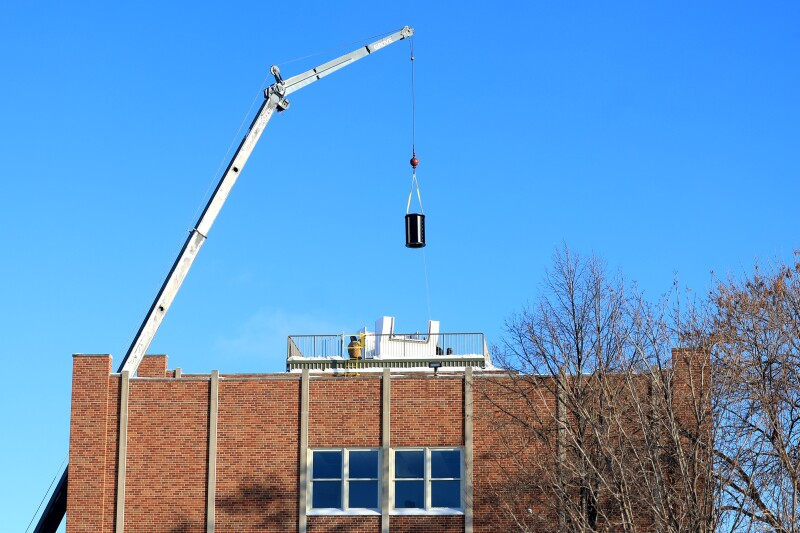
A groundbreaking research initiative at the University of North Dakota (UND) has successfully established a new Free-Space Optical Communication Lab designed to facilitate satellite communication via lasers. The lab, situated at Witmer Hall, will benefit both local businesses and university students by enhancing their capabilities to communicate with satellites.
Dr. Markus Allgaier, an assistant professor specializing in physics and astrophysics, spearheaded the project, which was made possible through collaboration with UND Facilities and local contractors. “There’s nothing here that comes from too far away,” Allgaier noted, emphasizing the local investment involved.
Lab Details and Installation Challenges
The lab comprises two main sections: an observatory on the roof and a standard laser lab located in the basement of Witmer Hall. The observatory will house a telescope equipped with optics necessary for pointing lasers at satellites and collecting data from them. According to Allgaier, this data collection is the most technically challenging aspect of the project.
Initially scheduled for installation on December 9, 2023, adverse weather conditions, including wind and snow flurries, postponed the setup until December 10. Even then, delays pushed the installation to 1 p.m. “It was exciting, but also stressful,” Allgaier reflected. “I’ve not had a project ever in my career where you’re planning for two and a half years and then it comes down to one day.”
The basement lab features controlled temperature environments and laser tables designed to minimize vibrations, ensuring that experiments can be conducted without interference. This facility aims to create a turnkey solution for laser communication while also addressing critical research questions.
Community and Educational Impact
The establishment of the lab aligns with local workforce needs. The Space Development Agency (SDA) will operate its satellite partially from the nearby Grand Forks Air Force Base, with some local contractors engaged in satellite link operations and ground station construction actively recruiting from UND. Allgaier emphasized, “We can train students from the region for jobs in the region that need that kind of skill.”
Funding for the project was secured through a request made by UND prior to the 2023 legislative session. The university received $5 million, which was reinvested into the local economy by hiring contractors such as Sand Steel from Emerado and AE2S.
Students have already begun utilizing the basement lab for experimental work. This includes three PhD candidates, one Master’s student, and several undergraduates engaged in senior projects. Allgaier is considering the introduction of upper-level electives related to optics and laser technology to further enhance educational opportunities.
“All students at UND can use the facility,” Allgaier explained. He anticipates that the lab will foster collaboration among various departments, enhancing interdisciplinary research and innovation.
Allgaier began planning the lab before relocating to Grand Forks, officially starting his role at UND in January 2024 after signing his contract in March 2023. His previous experience includes building three other optics labs, but this project allowed him to create a wish list for desired features, making it particularly special.
The lab represents a significant step forward in overcoming the “chicken and egg” problem associated with laser communication technology, as highlighted by Allgaier. He noted that while there was skepticism regarding the feasibility of laser communication for ground stations, the establishment of this lab marks a strategic move towards advancing such technologies.
By the end of spring 2026, all hardware will be in place at the lab, although it will take additional time to assemble and finalize the setup. Allgaier remains optimistic about the future applications of this technology, asserting the necessity of faith in its potential to revolutionize satellite communication.