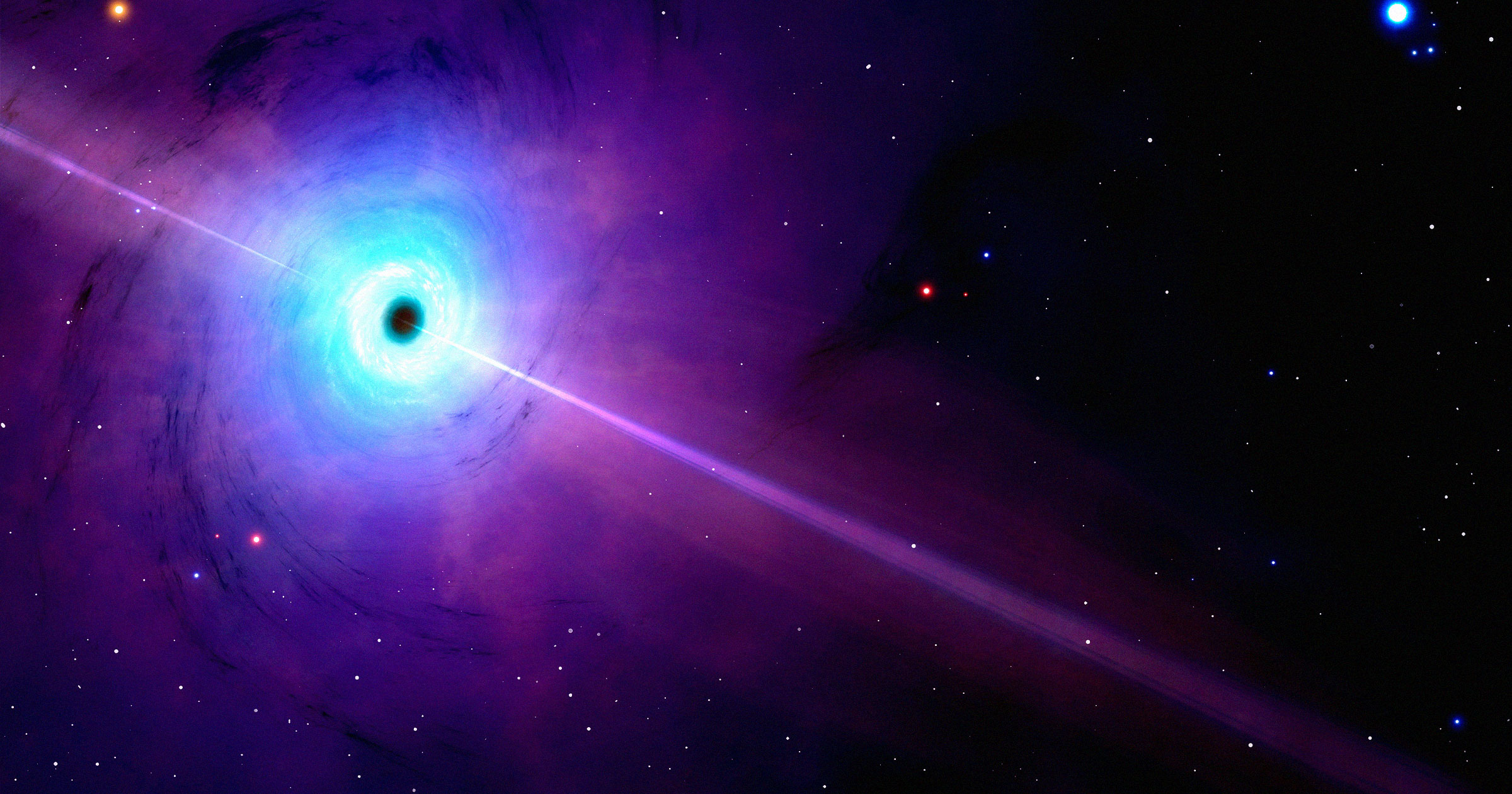
An international team of astronomers has made a groundbreaking discovery with NASA’s James Webb Space Telescope: they have identified the first known runaway supermassive black hole, traveling at an astonishing speed of 2.2 million miles per hour. This extraordinary celestial object, which is approximately 10 million times the mass of the Sun, is currently located in the Cosmic Owl, an interacting pair of galaxies situated around eight billion light-years away.
Supermassive black holes are typically found at the centers of galaxies, where their immense gravitational forces capture anything that comes too close, including light. While astronomers have frequently observed such black holes, their formation and behavior remain largely enigmatic. The discovery of this runaway black hole adds a new dimension to our understanding of these cosmic giants.
According to Pieter van Dokkum, an astronomer at Yale University and the lead author of a paper discussing this finding, the forces required to eject such a massive black hole from its home galaxy are significant. “It boggles the mind!” he remarked. “This is the only black hole that has been found far away from its former home, making it the best candidate for a runaway supermassive black hole.”
The team first identified this intriguing object in 2023 using the Hubble Space Telescope. However, detecting a black hole moving through space has its challenges due to its event horizon, which absorbs light. Fortunately, the advanced capabilities of the James Webb Space Telescope allowed researchers to analyze the substantial amounts of gas being displaced in front of the black hole.
Van Dokkum explained, “It is moving at approximately 620 miles per second, faster than just about any other object in the universe. This high speed enabled the black hole to escape the gravitational force of its former home.”
The researchers propose two potential scenarios for how this supermassive black hole was ejected. One theory suggests it may have collided with another black hole, generating a massive wave of gravitational waves that propelled it away at high speeds. Alternatively, it could have interacted with a binary black hole system, leading to instability and its subsequent ejection—a phenomenon known as a “three-body interaction.”
Van Dokkum believes that this particular runaway black hole is more likely to have been ejected from a collision with a single black hole. “Mergers happen often in the life of a galaxy,” he noted. “Each galaxy with the size and mass of the Milky Way has experienced several during its lifetime, so black hole binaries should form pretty regularly.”
The implications of this discovery extend beyond the individual black hole. As van Dokkum stated, “What we don’t know is how quickly these binaries merge, if at all, and how often the resulting kick removes a black hole.” He remains optimistic about future findings, asserting that now that astronomers have a method to identify these runaway black holes, they can explore the universe for more examples and gather concrete data on these extraordinary events.
Astronomers continue to be fascinated by the mysteries surrounding supermassive black holes. This discovery not only highlights the capabilities of the James Webb Space Telescope but also enhances our understanding of the dynamic processes that shape galaxies. As more research unfolds, the astronomical community looks forward to uncovering additional insights into the behavior of these colossal entities.