The sound produced when peeling adhesive tape has long intrigued both scientists and casual users alike. A recent study led by Er Qiang Li and colleagues, published in Physical Review E, sheds light on the underlying mechanics of this distinctive noise. The research identifies the role of supersonic air pulses and shockwaves generated during the peeling process, which can be startlingly loud, even across an open-plan office.
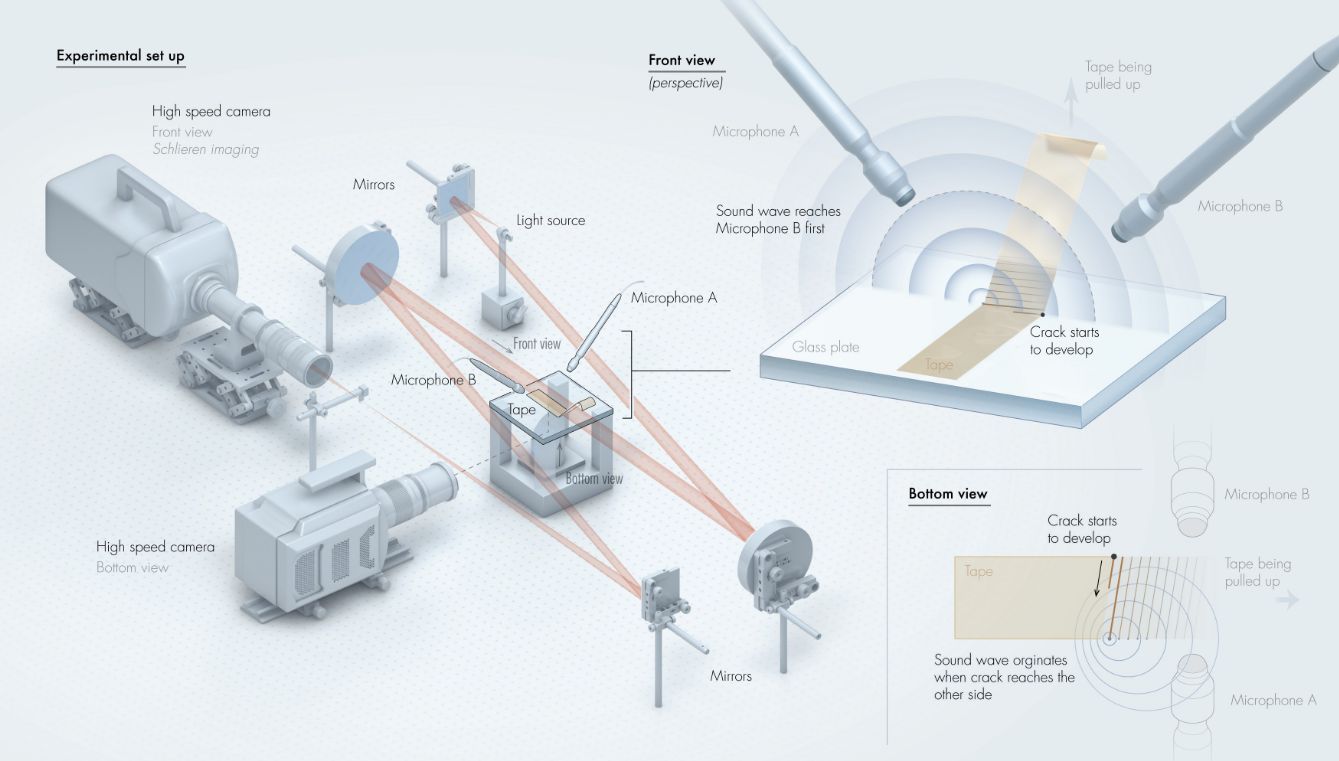
To investigate this phenomenon, the researchers employed a sophisticated setup that combined rolls of adhesive tape with two microphones and high-speed cameras within a Schlieren imaging system. This combination allowed them to capture the intricate details of what happens at the microscopic level when tape is peeled away from its roll.
One of the key findings from their experiments revealed that the peeling process involves a series of sudden fractures, which occur after a prolonged sticking phase. These fractures create a vacuum that collapses dramatically during the brief slip phase. This collapse generates a pressure of 9600 Pa, resulting in shockwaves that are visually represented in the Schlieren images taken during the study.
Interestingly, adhesive tape does not only produce noise; it is also known for its triboluminescence, a phenomenon where light is emitted due to friction. Additionally, peeling tape can even generate X-rays, making it a compelling subject for scientific demonstrations beyond its everyday applications.
While the findings do not offer a solution to the inherent noisiness of peeling tape, they certainly contribute to a greater understanding of this common activity. As researchers delve deeper into the mechanics involved, the peeling of tape transforms from a mundane task into a fascinating illustration of physics in action, further emphasizing the complexities hidden within everyday objects.
This new insight adds to the allure of adhesive tape, showcasing its unexpected role in scientific exploration while reminding us that even the simplest actions can reveal profound scientific truths.