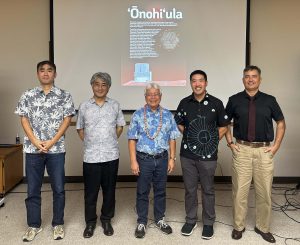
The Subaru Telescope has officially named its advanced Prime Focus Spectrograph (PFS) ʻŌnohiʻula, merging scientific inquiry with the cultural legacy of Hawaiʻi. This new designation reflects a commitment to understanding the cosmos while honoring the local heritage. The announcement was made during a naming ceremony held on November 19, 2023, at the Subaru Telescope’s base facility in Hilo, Hawaiʻi Island.
The PFS is a cutting-edge instrument capable of observing approximately 2,400 celestial objects simultaneously, covering a wide field of view. It gathers spectral data across an extensive wavelength range from visible to near-infrared light in a single exposure. Since its full science operations began in March 2025, the spectrograph has played a pivotal role in large-scale surveys related to cosmology, galaxy evolution, and the structure of the Milky Way.
At the ceremony, Professor Larry Kimura from the University of Hawaiʻi at Hilo presented the name ʻŌnohiʻula. The name carries significant meaning; the term ʻŌnohi signifies “what one perceives from their sight,” reflecting the telescope’s function as an observational instrument. The component ʻula translates to “red,” which symbolizes the redshifted galaxies that the PFS will study and the exploration of early cosmic history.
Professor Kimura elaborated on the name’s cultural significance, stating, “The name ʻŌnohiʻula represents the spectrum of the rainbow that we can see here, on the ground on Earth, and the eye of the instrument and in particular the color red, a sacred color which is associated with what we call the heavens in Hawaiian culture.” This connection between advanced scientific tools and Native Hawaiian perspectives underscores the Subaru Telescope’s mission to honor both global astronomical research and the cultural relevance of Maunakea.
The importance of cultural engagement was further emphasized by Professor Naoyuki Tamura, PFS Project Manager, who remarked, “ʻŌnohiʻula represents not just a powerful new eye on the Universe, but a commitment to conduct that exploration in conversation and collaboration with the people and place of Hawaiʻi.”
Professor Hitoshi Murayama, principal investigator of the PFS, expressed gratitude for the name, stating, “Our instrument received a beautiful name in the Hawaiian language. It represents the science of PFS very well. I have a renewed resolve to make sure we will produce exciting science with ʻŌnohiʻula PFS just as this name indicates.”
As the Subaru Telescope embarks on this new chapter of discovery, the integration of Hawaiian culture into its scientific framework exemplifies a progressive approach to astronomical research, fostering collaboration and respect for the local community.